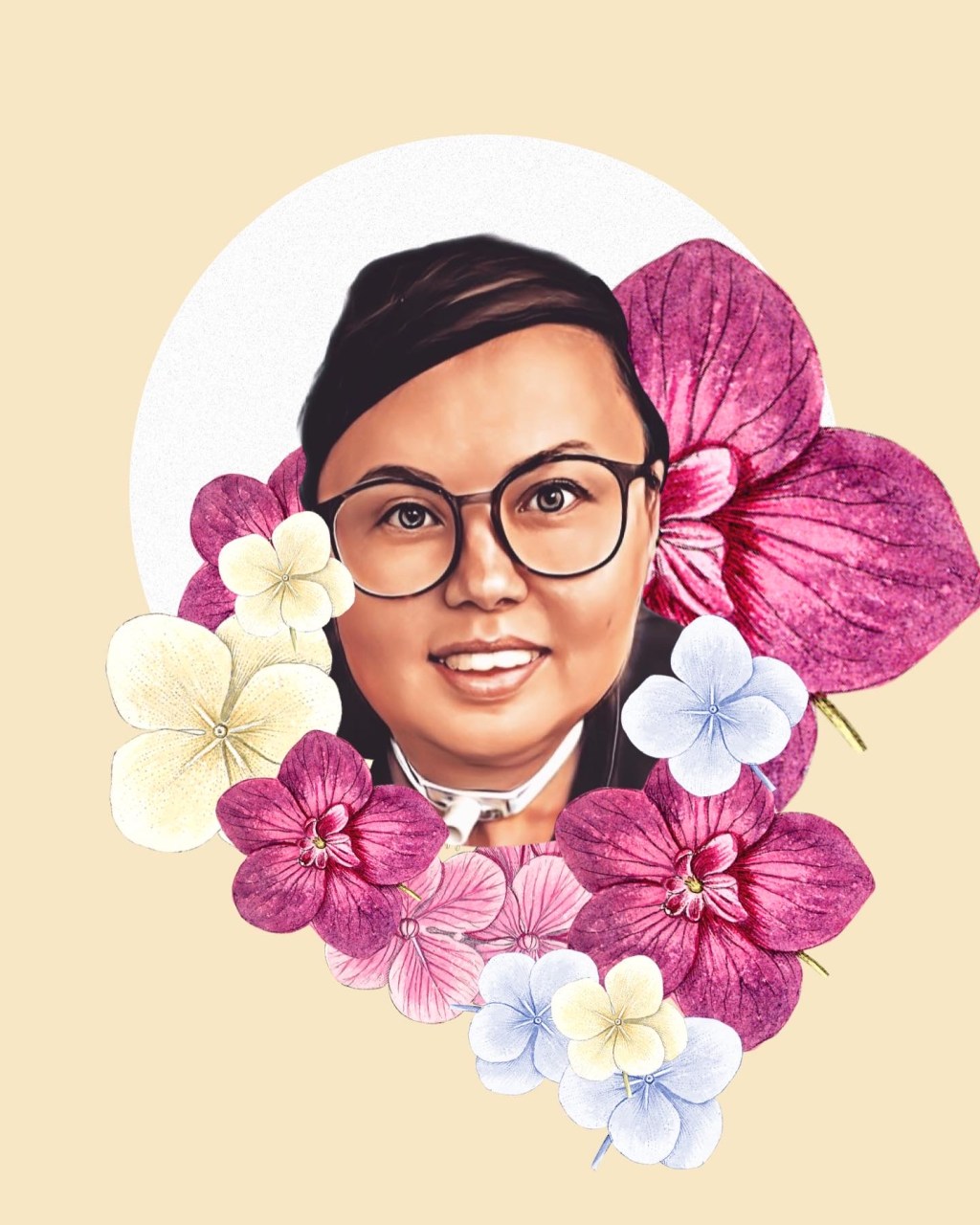
When my friend and comrade Stacey Park Milbern died on May 19, 2020, I had one of those moments you have when someone dies, snarled into your blankets clutching a cell phone. I made a promise to myself, and to her, that I would create an accessible writing residency by and for queer and trans Black, Indigenous and/or People of Color disabled, Deaf, Mad, sick and/or neurodivergent writers, and I would make it in her honor and memory.
Four years later after a ton of research, learning, searching for accessible residency spaces, dead ends, fundraising, applying for and getting fiscal sponsorship, trying stuff, stuff falling apart, and learning, I am honored to announce that the pilot Stacey Park Milbern Liberation Residency is launching its first iteration in July 2025 at the LOVE Building in Detroit, MI, supported by Allied Media Projects.
why the project/ who is/ was this femme
While many people think of Stacey primarily as an organizer, I met her as a writer and I never stopped thinking of her that way. I first encountered her work through her legendary, semi-anonymous blog, cripchick, written in her parents’ basement when she was still a teenager. Her poetry meant a lot to me and a lot of other people, and I’ve taught pieces of hers in disabled BIPOC writing classes for years. We did a lot of organizing together but we also wrote together for years, shared drafts, schemed on pieces, cheered each other on. We are two collaborators on the essay, “Pieces of Us: The Telling of Our Transformation,” written for the late great independent feminist magazine Make/Shift in 2011.
Stacey never stopped writing or being involved in creative work, and her writing was a core way she organized- essays, poems, performance and Facebook notes that were short, brilliant essays. She learned a lot from being in community with developmentally and intellectually disabled young people from an early age, and her writing held a lot of hallmarks of plain language culture. She was a maestra at breaking down complex ideas in ways anyone could understand, that were swift and beautiful.
In fall 2019 I was ecstatic when Stacey told me she was finally working on a book, and asked me if I would read her drafts as she was working on it. She died before she could complete it. In her last year on the planet. she was working a full time day job, being a full time (or let’s be real, more like two or three jobs) organizer, and also doing the full time job of managing both her existing disability and a new cancer diagnosis within an ableist medical system that did not have enough space for her. Something else always came first before her writing.
It’s one of the big heartbreaks of my life that she died before her book could be born. It’s one of my big rages, the ways existing literary spaces- residencies. but MFAs, writing programs, awards, classes- just don’t make any fucking room for disabled, working class, BIPOC writers. I don’t just mean the bare, inadequate minimum of “ADA accessible.” I mean the much broader world of what “access” could mean, that disabled creators I know and work to create. Where “access” is about physical and cognitive and language access and also about power. That the space is created by us and for us, with our understandings of what a disabled/ tired/ sick/ “I have a condition”/ Mad/ ND/ Deaf writing life can mean.
I’ve written a much longer piece about the four year process of making this residency. The shorter version I’ll share here is: in the community survey I did asking disabled QTBIPOC writers what they needed in a residency, so much of those different ways of access became clear. Like people needing it to be a space they could bring their kids. Like in classic “residency space” there’s this idea that a residency space must be located in a “pristine wilderness” miles from cell reception, but most people I talked to were like, that’s actually stressful, I need to be able to get delivery and my wheelchair fixed.
For a long minute I thought I would fundraise and buy a rural or semi rural place and live there and have the residency space in a mother in law building in my backyard. But then I figured out I both didn’t have money to do that, and, access barriers to travel- like, a lot of people can’t fucking fly because of claustrophobia or bloodclots or papers, or it’s a big risk because the airline will break their wheelchair- plus more and more climate crisis events every year making no place immune from heavy weather, mean that if the residency was in one fixed geographic location, not everyone would be able to get there.
I’m grateful to everyone who answered the community survey in 2022, to Borealis Philanthropy’s Disabled Joy Grants and some private donors for giving me money to fuel this disabled joy, and to Autistic Women and Nonbinary Network for fiscally sponsoring this project.
Please watch this space for more info as we get ready to make this place together.
 LIVING ALTARS